Periodically I review books related to science communication. This is a review of Houston, We Have a Narrative: Why Science Needs Story by Randy Olson (2015, University of Chicago Press, 256 pp).
Randy Olson is a former marine biologist who gave up his tenured professorship to move to Hollywood and become a film-maker. With "Houston," he builds on his earlier book ("Don't Be Such a Scientist") and the experience he has gained from the story-telling world of movies. The book has a simple message for scientists - you need a narrative.
It's not that simple, of course, and Olson does a great job of introducing some simple methods scientists can use to communicate their science to other scientists and to the public. He emphasizes that the key to storytelling is to find the narrative core - the message people will take away. He employs what he calls a WSP Model, the shrinking down of the core message to one word, one sentence, and one paragraph. Two principle techniques are what he calls the Dobzhansky Template ("Nothing in _______ makes sense except in the light of ______.") and ABT.
ABT really is the central point of the book. The story should follow an AND, BUT, THEREFORE structure. Much of the book discusses what this is, how to develop it, and techniques for using it to communicate your story. It's simple, but powerful.
There is much more: the Heroes Journey, the Logline maker, the story templates. And let's not forget McKee's Triangle of three pure story forms - antiplot, miniplot, and archplot. The archplot is the key. Study it, learn it, use it.
As examples he explains how the communication of climate change is "Bo-ho-horing" and fits a classic "miniplot" storyline. The combination creates a communications mess that explains why the public still doesn't understand the urgency. That's a problem.
Olson's writing style is mostly fluid and with a wisp of humor threading through it. He leans a lot on his own experiences, both in the science world and the film making world. I would highly recommend all scientists to read the book and practice the techniques. Your colleagues and the public will understand you a lot better.
Science, policy, and politics. Focus on science communication and climate change. The Dake Page offers news, analysis and book reviews.
Showing posts with label book review. Show all posts
Thursday, March 29, 2018
Thursday, July 27, 2017
Nature's Allies: Eight Conservationists Who Changed Our World by Larry Nielsen
Today we review a book providing eight succinct biographies of key conservationists - Nature's Allies: Eight Conservationists Who Changed Our World, by Larry Nielsen.
As the subtitle suggests, the book consists of eight chapters, each of which gives a short biography of a highly influential and consequential conservationist. Some of the eight will be familiar to most everyone, others not so much. The book brings their stories in roughly chronological order with respect to their lifespans and periods of activity.
Early chapters deal with well-known conservationists like John Muir and Rachel Carson, along with Aldo Leopold and Ding Darling. Despite being more recent, Chico Mendes, Billy Frank, Wangari Maathai, and Gro Harlem Brundtland may be new names for many people.
Nielsen provides a succinct review of their upbringings and the events that led them to become "nature's allies." There are similarities with all - most spend considerable time roaming in nature during their youth, for example - but also differences. Unexpectedly, most were very comfortable meeting new people and working with others (Carson being the notable exception). All were highly self-motivated and caring of both nature and humanity. Most of them had a primary focus for their attention: Muir for the Yosemite valley, Carson for the sea (as well as the more famous "poison book" about DDT), Mendes for rubber tappers in Brazil, Frank for Native American fishing rights in the northwest.
Three of the eight are women, including the last two profiled. Maathai focused intensely on planting trees with a sustainable ecology in mind; Brundtland was broader, both in terms of seeking a sustainable world and her participation in the political process. Where the others were outsiders working to get insiders attention, Brundtland was Environmental Minister and then Prime Minister in Norway, which allowed her to direct a societal appreciation for sustainable growth.
Overall the book is well written and easy to read. It would be great for anyone wanting quick insights to some key people in the history of conservation.
Thursday, July 6, 2017
If I Understood You, Would I Have This Look on My Face? by Alan Alda [Book Review]
Next in my periodic series of book reviews is Alan Alda's newest book on science communicating, If I Understood You, Would I Have This Look on My Face? My Adventures in the Art and Science of Relating and Communicating, published in June 2017.
As a scientist and author concerned about how we communicate with the general public, I was eager to read this book by revered actor Alan Alda. The book reiterates and expands on a lecture I saw him give a few days ago. Between the two I learned a lot about improving communication. Alda mixes anecdotes and stories from his own experience, both as an actor (M*A*S*H, West Wing, movies, etc.) and his lifelong interest in science that led to him hosting Scientific American Frontiers for 11 years. Recently he helped establish the Alan Alda Center for Communicating Science at Stony Brook University, where many of the techniques discussed in the book were developed and are currently used to teach communication skills to scientists.
The first of two parts includes eleven chapters and primarily focuses on laying the groundwork for communication. He emphasizes the importance of empathy and "theory of mind." The ten chapters in the second part delve more deeply into the scientific studies conducted to investigate the skill sets being taught.
Much of the training incorporates the concept of improvisation, or Improv. This is a technique often used by actors (and more famously by comedians) to entertain without a script. In this case, the technique is used to help scientists and others to learn how to "read" the person they are trying to communicate with. Games such as "the mirror exercise" help participants learn empathy, a mutual understanding of the person you're speaking to.
There is much more to the book than one might expect from an actor. Alda has taken his goal of helping scientists communicate seriously, proposing and participating in studies to determine the best methods for teaching others. He provides a strong scientific basis from the studies he describes and has worked with or interviewed professors and practitioners of these methods.
Based on my own experience (it's part of the reason I left a scientific consulting career to pursue writing and expanding public knowledge of science and history), the book is both scientifically robust and entertaining to read. While the focus is on helping scientists to better communicate, the lessons imparted will also be useful for all of us who wish to be better understood by - and to better understand - our fellow members of the public. Alan Alda should be commended for his contributions in this much needed area.
Thursday, June 22, 2017
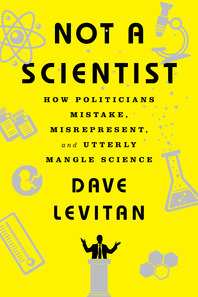
Not a Scientist: How Politicians Mistake, Misrepresent, and Utterly Mangle Science by Dave Levitan [Book Review]
Today's book review is of Dave Levitan's Not a Scientist: How Politicians Mistake, Misrepresent, and Utterly Mangle Science, published in April 2017.
I tag this is an important book that everyone should read, while recognizing that the people who need it most will refuse to do so. The main title is derived from the oft-heard refrain from Republican politicians in the year or so leading up to the recent presidential campaign: "I am not a scientist." Invariably this meaningless throwaway line was followed by some statement that was both false and already refuted by the science.
Each chapter of the book introduces one of a series of what the author calls mistakes, misrepresentations, and errors. [I would call them tactics] They include the "oversimplification," "cherry-pick," "butter-up and cut," "demonizer," "blame the blogger," and so forth. Some of these will sound familiar and others not, but all are common tactics used by politicians to mislead the public and give cover for fellow science-denier legislators. The examples he uses will be recognizable by most people who watch or read the news.
The "oversimplification," for example, is done by boiling down a complicated science into a simple statement that appears to be true and definitive (though is likely to be neither). The example he gives is when several Republican politicians argued "the scientific evidence is clear" that unborn babies at 20 weeks feel pain. In fact, there is essentially no scientific evidence supporting this argument (and much evidence to refute it), but by stating something as settled fact that isn't settled fact they are able to push their anti-abortion agenda.
On the flip-side of this is the "certain uncertainty" tactic. Republican politicians often claim that since we don't every single detail of man-made climate change (e.g., how many feet the seas will rise by 2030 or the temperature by 2050) then we should not take action. Politicians who don't want to take action on climate change demand absolute certainty to avoid responsibility; politicians who do want to take action to block funding for women's reproductive choices claim as certainty conclusions that are in no way certain. In both cases, politicians are selectively choosing a tactic that misrepresents the science for their political gain.
There are two aspects of the book that I believe keep it from reaching the entirety of its potential. First, the format of each chapter is to introduce examples from politicians mouths to illustrate the tactic being discussed. This is a good start, but then Levitan spends considerable time documenting the research that debunks that particular politician's statement. I agree that explaining the reality is necessary to show the fallacies, faults, and fallaciousness of the statements, but in my opinion these discussions go on way too long. The author is a respected journalist and does an excellent job digging out the background behind the statements, but I wish he had covered the material more concisely so that he could provide more examples and more insights into how to recognize these tactics. No casual viewer or listener of these political statements is going to do investigative reporting to know that the statements are false. The public needs to be able to recognize in real time when politicians are misleading them.
The second aspect is that Levitan works hard to avoid calling a lie a lie. Many of the tactics he describes as errors and misrepresentations are intentional. The carefully constructed "literal nitpick" of James Inhofe, for example, is done intentionally to misinform the public so that they won't call him out on the science denial that negatively impacts his constituents (but greatly helps his campaign donors, and future donations to his coffers).
[See this article on The Dake Page for more discussion of this James Inhofe example]
Considering the critiques above, I think the book falls short of what it potentially could have accomplished. That aside, I also highly recommend that everyone read it. The tactics that Levitan discusses are used repeatedly by politicians - mostly, but not exclusively, Republicans - and the general public MUST be aware of how science deniers intentionally misrepresent the science. Why the capital letters "MUST?" Because denial of science, and the resulting abdication of responsibility to take policy action to address it, endangers each and every American (not to mention everyone else on Earth, and Earth itself).
Thursday, March 9, 2017
Letters to a Young Scientist by E.O. Wilson
Part
memoir, part mentoring, and part history of science, ecological icon
E.O. Wilson offers up this series of 20 letters of advice to those
beginning - or thinking of beginning - a life in science.
Wilson examines how to choose a path to follow, the widely variable creative process, what a life in science entails, and bigger picture dynamics. Along the way he provides insights from his own path and the field on which he is a renowned expert - ants.
His final letter concerns the scientific ethic, in which he emphasizes a scientist's relationships with other scientists. His final advice reminds me of Abraham Lincoln's counsel to "if in your own judgment you cannot be an honest lawyer, resolve to be honest without being a lawyer." Wilson's version for scientists is "But never, ever will fraud be forgiven. The penalty is professional death: exile, never again to be trusted."
There are many wise words from this most accomplished and wise man. While designed to inspire and advise young scientists, the book is well worth reading for scientists at any stage of their career.
[NOTE: This is part of a series of reviews for books related to science, science communication, and/or specific science topics such as climate change. To read reviews of other books, click Book Reviews.]
Thursday, January 12, 2017
Climate Change: What Everyone Needs to Know by Joseph Romm
A
tremendously valuable book that everyone interested in climate change
should read. And we all should be interested in climate change.
Written by a former assistant secretary of energy, with a PhD in physics and decades of science communication expertise, the book, subtitled "What Everyone Needs to Know," covers major facets of climate change in seven major sections. Each section is broken into the questions that most people ask.
For example, section 1 is on Climate Science Basics. It includes questions like: "What is the greenhouse effect and how does it warm the Earth?" and "Why are scientists so certain the climate system is warming?" These and other questions (like Where does most of the human-caused warming go?) become the focal point for detailed answers explaining the state-of-the-science.
This same format is used for each of the other sections encompassing: Extreme Weather and Climate Change; Projected Climate Impacts; Avoiding the Worst Impacts; Climate Politics and Policies; The Role of Clean Energy; and Climate Change and You.
The coverage of impacts and policy options in addition to the science makes this book highly useful. Is nuclear power part of the answer? How about "carbon capture and storage?" Bioenergy? Electric cars? Hydrogen cars? What contributions, impacts, and solutions are there in the agricultural and livestock sector? How about transportation?
The last section - Climate Change and You - helps bring the ramifications of climate change back home. What impacts, now and in the future, can your family expect? What can you do as individuals to reduce your carbon footprint? How might this affect your investment decisions?
And "Do we still have time to preserve a livable climate?"
The table of contents lists each of the questions (roughly 12 to 20+ per section) so that readers can go directly to the discussion of the questions most important to them. This makes the book an excellent future resource as well as a comprehensive survey of the science and the options for dealing with that science.
As might be expected, the book is dense with factual information. This is both a blessing (well documented facts abound) and a burden (it is not a quick read). My recommendation is that everyone who wants to know about climate change (or who professes to "know" in Facebook comments) reads this book thoroughly, then keep a copy on your desk for reference. The questions likely any question that may be asked by friends, family, or on online forums.
Read it, and keep it handy.
Thursday, December 15, 2016
The Madhouse Effect by Michael Mann and Tom Toles
This
is a book every American should read, and read now. The Madhouse Effect: How Climate Change Denial is Threatening Our Planet, Destroying Our Politics, and Driving Us Crazy
sports a "Global Warming Meets Edvard Munch" cover, but that shouldn't
be taken as a lack of seriousness. The book's authors - award-winning
climate scientist Michael Mann and Pulitzer Prize-winning political
cartoonist Tom Toles - have attempted to bring both climate science and
climate denial to the forefront. Using Toles's creative genius and
Mann's scientific depth, and more than a smidgen of subtle humor, the
two have succeeded masterfully.
This short book is a quick read and written in a style that is accessible to everyone. In short, it's the book I planned to write but never got around to. The eight chapters are easy to breeze through, but when you reach the end you realize you've learned a lot more than you anticipated.
It begins with a chapter on how science works, a topic that it appears most of the public hasn't yet grasped. It's also an introduction of sorts to how lobbyists and hired guns intentionally distort the science (but more on that later). Mann and Toles note that science is unique in that it is "self-correcting" by its very nature. Scientists publish their research, and other scientists challenge it. If someone got something wrong, the process is designed to find that out and correct the misconception. The chapter also clarifies the idea of skepticism. Scientists are inherently skeptical; it's what makes us tick. But most of the people who claim to be skeptical when they deny the science aren't skeptical at all.
The second chapter provides some of the basics of climate science. The first paragraph puts it all in context:
"The basics of climate science are actually very simple and always have been. Carbon dioxide in the atmosphere traps heat, and we are adding more CO2 to the atmosphere. The rest is details."
They then go on to explain in general terms the "Physics and Chemistry 101" of climate change, plus some of the effects such as more extremes, rising sea levels, warmer atmosphere, ocean acidification, and melting ice. The chapter ends with a discussion of tipping points, an area of both great uncertainty and grave ramification.
Chapter 3 is perhaps the most important chapter: "Why Should I give a Damn?" In it they discuss the effects of climate change on national security, food production, water supplies, energy resources, land use, human health, and ecosystem disruptions. If none of that concerns you, how about the massive negative effect on the economy resulting from not doing anything? In short, you better give a damn because this is your life being impacted, and your children's and grandchildren's lives.
The next three chapters address the actions of climate deniers. Chapter 4 outlines the six stages of denial; Chapter 5 the war on climate science (here are those lobbyists and hired gun men mentioned earlier); Chapter 6 on the hypocrisy of climate denial. These are important chapters for anyone who believes Fox News and the conspiracy/white supremacy blog Breitbart are somehow "science" while NOAA, NASA, IPCC, and WMO are "in it for the money."
Chapter 7 hits on geoengineering, the idea that somehow we can find some technological fix. In short, it's akin to trying to find ways of keeping a bathtub from overflowing by throwing in toasters or blasting the rising water with a propane torch in an effort to evaporate it. These ideas are likely to 1) not work, and 2) have unintended consequences. Of course, the alternative is to turn off the tap and pull the plug. Duh.
The book ends on a more hopeful tone, as Chapter 8 delves into a path forward. What may come as a surprise to many folks is that we've already been working to reduce carbon emissions and shift from fossil fuels to renewable sources of energy. The world, through the leadership of the Obama administration, has taken significant steps toward righting the ship. More needs to occur.
Throughout the book are the cartoons of Tom Toles. Toles has an exceptional knack for taking the key points and boiling them down into an easily understood comic drawing. The cartoons heighten the value of the book tremendously. And don't miss the teeny toons in the bottom right corner of every cartoon; they too exquisitely capture the important moments.
This book is especially important given that the apparent incoming administration (this review was published on 12/15/16, a month or so after the 2016 election) has said it will make Rex Tillerson, CEO of ExxonMobil and a long-time funder of climate denial front groups, as the next Secretary of State.
So read this book. It reads fast. It provides excellent information. And it is necessary for all Americans to understand what we are up against.
More book reviews (click and scroll down)
Thursday, October 27, 2016
The Disappearing Spoon by Sean Kean
The full title of this book is The Disappearing Spoon: And Other True Tales of Madness, Love, and the History of the World from the Periodic Table of the Elements by Sean Kean.
The spoon that disappears is made of gallium (Ga, Atomic Number 31), a metal that melts at around 86 degrees Fahrenheit. One scientific party gag was to serve tea in Victorian parlors and watch the guests as their teaspoons slowly dissolved away. Scientists are fun that way.
The book is a surprisingly entertaining as well as informative read.
Kean takes us through a tour of the periodic table of elements, the mainstay of chemistry and physics. As exciting as that sounds (or not), the tour actually includes murder and madness, love and attraction, and a whole lot of history.
Early in the book the focus is on the development of the table itself as scientists started to notice patterns of characteristics. Not surprisingly, these patterns relate to the deep-diving chemistry and physics of elements and you'll probably learn more about orbital shells and subatomic anatomy through this book than your introductory science class.
The author goes on to examine specific elements and groups of elements as they come to be known, all while giving a voyeur's look into the often mischievous (and sometimes mad) world of the scientists - both male and female - who discovered them.
Most science and history loving readers should find this book fascinating. Kean's writing style is jam-packed with information and yet easy to read. And even sometimes downright fun.
The book is definitely worth reading.
Other scientific book reviews (click and scroll down)
Thursday, September 1, 2016
Weapons of Math Destruction: How Big Data Increases Inequality and Threatens Democracy, by Cathy O'Neil (Book Review)
A
hugely important work filled with knowledgeable insights, this book
takes a hard look at the promises and pitfalls of big data. Mostly
pitfalls. Written by an insider data scientist, the book's title riffs
off the infamous Weapons of Mass Destruction (WMDs) of a decade ago,
trading the Mass for Math. The clever theme continues with chapters
labeled Bomb Parts (basics of mathematical modeling), Shell Shocked (the
author's path toward recognizing the problem), Arms Race (going to
college)...all the way through Collateral Damage and The Targeted
Citizen.
Along the way author O'Neil examines how big data - mathematical models - are now used to determine who gets into college, how corporations target advertising to specific groups, whether you get and keep a job, and assessing credit ratings and insurance risk. Through insider interviews and personal experience, O'Neil documents how model building often integrates the inherent biases of the people building the models, as well as historical biases. In many different ways, and through dozens of pertinent examples, it becomes clear that WMDs are designed primarily to reduce costs and promote higher income for the companies that use them.
Worse, WMDs reinforce societal prejudices and stereotypes, targeting - even if sometimes unintentionally - the poor and minorities, further driving them downward and limiting opportunities for upward movement. The poor are kept poor by reducing access to affordable loans, depressing credit scores, and blocking job options through linkage to factors that are irrelevant or biased. And because these models are black boxes both to the people held back because of them and, often, the people administering and using them, there often is no way to even know why rejections have occurred. Without the model feedback seen in more useful models, these WMDs cause their destruction with no hope of ever improving the algorithms used.
O'Neil jumps from the financial crisis of 2008 to the removal of teachers unfairly to how Google and Facebook influence behaviors simply through their choice of what people see in their feeds - and who gets to see it.
As models, algorithms, automation of processes, and online data collection continue to become more prevalent, and potentially more destructive, this book becomes essential reading. Its valuable insights, whether you agree with everything the author suggests or not, are critical to our informed discussion of what we want our future to look like.
Available on Amazon.
Thursday, August 25, 2016
The War on Science: Who's Waging It, Why It Matters, What We Can Do About It, by Shawn Otto (Book Review)
The War on Science is a must read book for scientists and
anyone even remotely interested in science or policy or politics or
decision-making or life. Yes, that means you.
The book is actually much more than the title suggests. Shawn Otto (one of the founders of ScienceDebate.org) delves deep into the history of science, but also in the psychological, sociological, political, educational, and religious histories and their interactions with science. He points out that the early leaders of this nation were promoters of science. George Washington said "There is nothing which can better deserve our patronage than the promotion of Science and Literature." Jefferson heavily promoted science during his presidency and noted as he was leaving office that "Science is my passion, politics my duty." Great Republicans presidents such as Abraham Lincoln, Teddy Roosevelt, and William McKinley all emphasized the importance of science and technology. The author notes that Republicans were once the party of progressive optimism and tolerance, of environmentalism and finance, of rationalism and national parks. Only recently have Republicans turned against science. [But Democrats have their anti-science as well, which he discusses]
The reasons for this turn toward antiscience are discussed in great detail. Otto digs into the history of religious intolerance for science that contradicts scripture, most notably by the excommunication of Galileo (who, ironically, was devoutly religious), but also with many other examples ranging through history to today. He examines the interplay of antiscience and "freedom," including how fear of annihilation from Cold War/nuclear weapons led to the "live for today" attitude of the 1960s. But not just nihilism, this constant stress and attachment to the "military-industrial complex" caused a suspicion of science.
Further, the book delves into the turn towards postmodernism, which denied the existence of objective truth, claiming that all "truth" is subjectively in the eye of the beholder and that your opinion (often, ignorance) is as good as decades of scientific fact. This postmodernist belief severely damages education, where no longer are students expected to learn from accumulated facts but how they "feel" about reality. The media promotes this subjectivism, combined with the need to create controversy to garner ratings, as well as promote "false balance." All of these erode citizen confidence in science for no reason other than to assuage their fears of the unknown.
Otto also takes a closer look at the "three-front war on science" from identity politics, ideology, and industry. All three provide substantial and substantive background and analysis and should be read closely. The third, "The Industrial War on Science," is extensive and examines the long and fruitful strategies of industries (often working in tandem with religion and media) to deny established science and delay or eliminate any policy action. We saw this for decades as the tobacco industry denied smoking causes cancer, and today as fossil fuel and libertarian lobbyists deny man-made climate change, as well as many other examples. Otto documents in detail the tactics used by denier lobbyists and their hired spokespeople; even quoting from their own strategy materials. He shows also how companies like Exxon and the Koch companies shifted from paying directly to denier front groups to slipping the money in through "dark money" vehicles like Donors Trust and Donors Capital Fund.
The final three chapters look at "winning the war" in the sense of how do scientists and others battle against the misinformation of identity politics, ideologies, and industrial disinformation campaigns. In short, it isn't easy. Otto discusses how to engage in conversations in ways people can relate to. He also proposes a series of 14 "battle plans" to communicate science and overcome denial. The plans begin with something as simple as "doing something;" getting out there and trying to communicate. They continue with specific actions like creating a science advisory organization, pushing for science debates, using science advisors more effectively, and reaching out to religious, educational, and political leaders to help them understand the importance of science and its role in policy making. Otto also suggests that scientists need to fight back against the harassment, disinformation, and personal attacks of denial organizations.
All of this can get rather intense. The book is dense in both information and thought. Otto has done tremendous research in a wide range of science and sociological history to develop the incredible insights he displays in this book. I highly recommend that all scientists read it, but I also highly recommend everyone who has an interest in honest discussion and policy making to read it. Finally, every responsible American citizen should read it as it helps put into context our role as citizens in this democracy.
Amazon page for War on Science
Thursday, August 18, 2016
The Story of Western Science: From the Writings of Aristotle to the Big Bang Theory by Susan Wise Bauer (Book Review)
I
highly recommend this book. "The Story of Western Science" is indeed
presented as a story, or rather, a series of highly readable stories in
28 succinct chapters ranging, as the subtitle notes, from Aristotle to
the Big Bang (and the Butterfly Effect). Bauer's writing style is easy
and fresh, even when she is communicating difficult to understand
scientific concepts.
The author relies on the writings, i.e., the key historical books and texts, to illustrate each topic, though she brings in numerous other key scientists and writings to coherently fill in the flow of scientific knowledge.
The book is laid out into five Parts, each containing 5-7 chapters:
I. The Beginnings: Here she covers the first attempts to write down the principles of science as they are being developed, the first accounts of the universe, the first thoughts on evolution, the first mathematics to measure the universe, and the transition from an Earth-centered to Sun-centered understanding of our worlds.
For example, After introducing Plato's principles, the differences between him and his student Aristotle, the Archimedean calculations, and the Lucretian principles, she introduces the fundamentally and completely erroneous model of the universe as espoused by Ptolemy. She goes on to Copernicus and his more accurate, though still flawed and theoretical, heliocentric view. Along the way the author deftly points out the development of new ideas and theories, along with their many side tracks and sometimes century-long disappearances only to reappear in different forms and by different researchers.
II. The Birth of the Method: All of the early work by the ancient Greeks and others was largely ad hoc. In this section she traces the influence of Francis Bacon and the development of what would become the scientific method of inquiry. No longer reliant on undocumented grand theory, science would advance by following a system of observation, experimentation, and reasoning. This would be assisted by the improving of instruments and "helps" like telescopes, microscopes, and other devices of measurement and observation.
III. Reading the Earth: This part begins a series of three parts that take focused looks at geology, biology, and cosmology. Ironically, the science of geology got its start in astronomy. As scientists discovered more about the cosmos, they realized that the Earth is not so special, i.e., that it was similar to other planets. Thus, processes that effect other planets and moons, like meteor craters for example, could also happen here. This led to debates about whether changes in the Earth came about slowly by the same processes we see today (e.g., volcanism, erosion) or through catastrophic events (e.g., "the Biblical flood" or asteroid strike); uniformism vs catastrophism. Along the way there are conflicts between religion and science, the age of the Earth, continental drift, and others.
IV. Reading Life: Bauer takes a look at the first systemic attempts to categorize life on Earth. Debates about the origin of species, inheritance of traits and genetics, evolution, and biochemical development were widespread. Again she is able to tease out the key points from their technical basis and present them in ways readers can understand. The shift from the obtuse writing of Copernicus (in Latin) to the writings of Julian Huxley, intentionally designed to be read by a non-scientific audience, are brought to light.
V. Reading the Cosmos: In this final part she examines the broader investigations into relativity, quantum physics, the Big Bang, and Chaos. She shows the limits of Newtonian physics and how Einstein and others replaced it with space-time fluctuations that can be hard to understand even as she makes them more accessible. And then the replacement, of sorts, of that with quantum jumps.
All of this she does adroitly, extracting key principles and documenting the myriad steps and key players as our understanding evolves from one place to the next (sometimes going back steps or skipping steps, only to return to them later). Bauer has done a wonderful job showing how science, and scientists, works.
But Bauer goes one step further. Since she uses key writings of science over the ages as the skeleton on which she hangs her history, at the end of each chapter she tells you how to find the books. She even tells the reader which editions to obtain and which other secondary texts do a good job of explaining the more technical writings. In the front of the book she lists all of the key texts she refers to, separated by Part.
To reiterate, I highly recommend this for anyone who wants to get a solid history of the development of science from the beginnings to today. Bauer does an excellent job of making the science accessible without "dumbing it down."
[The Dake Page periodically reviews books related to science and science communication. To see other reviews click here and scroll down. Click here to reach the Amazon page for the book.]
Thursday, May 12, 2016
The Discovery of Global Warming by Spencer R. Weart
Spencer Weart takes us on a journey into the past. In The Discovery of Global Warming, Weart provides a history of the science that has now come to be known as Anthropomorphic Global Warming (AGW), or more simply, man-made climate change. In doing so he demonstrates just how robust and voluminous is the scientific case for human induced climate change.
He begins by recounting the early discoveries by such well-known names as Joseph Fourier, Guy Stewart Callendar, John Tyndall, and Svante Arrhenius. Lesser known scientists who also provided significant contributions to the developing science include James Croll, Vladimir Verdansky, Charles Greeley Abbot, Milutin Milankovitch, Gilbert Plass, Hans Suess, David Keeling, and many others. As he takes us through the years in come names such as Roger Revelle, Wally Broecker, J. Murray Mitchell, Ed Lorenz, and on to names more familiar to us in the modern day like Stephen Schneider, James Hansen, Gavin Schmidt and Michael Mann. In all, Weart reviewed a thousand studies and says that each study has 10 more like it and 10 more beyond that.
Weart’s narrative gives us a sense of the trials and tribulations of early scientists trying to make sense of myriad observations as they tested hypothesis after hypothesis. Was the Earth warming or cooling? What were the influences of sunspots, volcanoes, aerosols, and particulates? How does one deal with uncertainties and feedback mechanisms? As he describes the process we see how the science developed piece by piece in fits and starts as scientists first worked on the periphery of fields tangential to their own, then eventually grew to understand how the study of climate was inter- and multidisciplinary. All of these questions were addressed as technology advanced from simple hand calculations through early computers to the supercomputers used today. From simple measurements using thermometers to satellites that scan the globe day and night.
As the case for man-made climate change grew there became a need for a way to synthesis the thousands of studies into a cohesive summary of the state-of-the-science. Thus, the IPCC was born. As more data came in and was compiled the conclusions grew more concrete, from “discernible effects” to “unequivocal warming” and “very likely” (90-99% certainty) that warming was being caused by humans. Data since the last report have made the case for a human cause not even more certain, but the rate and magnitude of change is even greater than previously thought.
Anyone interested in global warming/climate change would do well to read this book. It provides a valuable history of the development of the science, and demonstrates without a doubt the robustness of the scientific consensus that the planet is warming and that human activity is the main contributor. As Weart himself says:
“the few who contest these facts are either ignorant or so committed to their viewpoint that they will seize on any excuse to deny the risk.”
The science is unequivocal; whether we act is our choice. A choice that has major ramifications for our future and the futures of our children and grandchildren.
Thursday, February 4, 2016
Reality Check: How Science Deniers Threaten Our Future by Donald R. Prothero
Periodically we review books relevant to science communication and climate change. Today is the book "Reality Check: How Science Deniers Threaten Our Future" by Donald R. Prothero published by Indiana University Press in 2013.
An author of over 30 books on science, Donald R. Prothero compiles a series of case studies involving denial of science and discusses how they endanger our future. Written in a conversational, colloquial style and a somewhat folksy, often condescending tone, the book lays out each chapter with the denier misinformation and contrasts these with the reality.
The book could have used much tighter editing - he's often repetitive and overtly belittling of deniers - but provides exceptional arguments drawn from his own experience and previous books to demonstrate the utter ridiculousness of the anti-science views.
Topics covered include acid rain, ozone hole, global warming, creationism/intelligent design, anti-vaxxers (anti-vaccination), AIDS denialism, medical quacks, astrology, peak oil deniers, and overpopulation. In early chapters and in a final chapter he discusses the basis of science and why some groups more than others are prone to science denial.
Overall, the book does an excellent job of showing the lack of veracity in all science denial arguments. Anyone interested in science, and the denial of science, should put it high on their reading list.
Thursday, November 12, 2015
Book Review - Fire in the Turtle House: The Green Sea Turtle and the Fate of the Ocean by Osha Gray Davidson
Climate change has already shown impacts not only on the world's temperatures but on ocean acidification, sea level rise, and effects on plant and animal migration behaviors, among others. The Dake Page periodically reviews science-related books.It isn't clear whether the impacts noted in Fire in the Turtle House are related to climate change or some other cause, but it reflects how quickly disruptions can result in catastrophic impacts on wildlife. What follows is a short review of Fire in the Turtle House: The Green Sea Turtle and the Fate of the Ocean by Osha Gray Davidson.
The Turtle House is an area in the narrow channel separating Maui from the neighboring island of Moloka'i. Not surprisingly it is a haven for sea turtles, especially the green sea turtle that the locals call honu. And the honu are dying.
The book follows the search for the cause of rampant spread of the disease called FP, most notably characterized by the growth of tumors on the soft tissues of turtles. First noticed in the 1960s, proliferating in the 70s, and clearly epidemic by the 80s, FP has decimated green turtle populations in Hawai'i as well as in Florida. Davidson visits with the key researchers, examines the different investigations into the cause, and personalizes the scientific struggle to understand. In the end the answers are still uncertain, though viruses are clearly implicated, and dinoflagellate biotoxins, human-caused stresses from pollution and nutrient enrichment, and other factors also may be part of the complex genesis that spreads the disease.
Overall this book is well written. It does seem to veer off on tangents, such as stories about Stellar sea cows from a century before, Pfeisteria-based fish diseases, and other sidetracks that eventually are laced back into the turtle narrative with varying success. On a personal note, it was interesting to see mention of names like Archie Carr and Joanne Burkholder and others familiar to my own marine biology days.
One drawback to the book is that it was published in 2001 and thus is somewhat dated. It would be nice to know where the status of the investigation, and hopefully treatment, of FP stands now. Still, I would recommend this book for those who are interested in learning how science works in the complex real world, and how human factors can surreptitiously drive what appear to be nature impacts.
More science-related book reviews can be read here.
Thursday, October 22, 2015
Book Review – Doubt is Their Product: How Industry’s Assault on Science Threatens Your Health by David Michaels
Given the recent revelations that Exxon knew how fossil fuels caused man-made climate change decades ago, then hid it, the following review of Doubt is Their Product: How Industry's Assault on Science Threatens Your Health, by David Michaels, is timely.
"Doubt is our product” is how a tobacco company executive once described the industry’s attempt to hide the fact that smoking cigarettes caused lung cancer and related diseases. And that is the theme that David Michaels uses throughout his book. He argues rather persuasively that the tactic of denying the science first perfected by the tobacco companies has been used over and over again by other industries. The goal – to protect profits and avoid litigation liability from exposing people to dangerous chemicals and other practices.
The book is replete with case studies and examples, many from his personal experience as an epidemiologist and a former Assistant Secretary of Energy responsible for protecting the health and safety of workers, neighboring communities, and the environment surrounding the nation’s nuclear weapons facilities. He talks about problems with lead and children, workplace cancers from beryllium, “popcorn lung” destruction from diacetyl, secondhand smoke, asbestos, chromium, vinyl chloride in plastics, diet drugs fen-phen, Vioxx, and nuclear radiation, among others. In each case the responsible industry delayed action and avoided taking responsibility while the regulators were hamstrung by a combination of insufficient authority, political unwillingness, and nearly always deficient resources.
Throughout the case studies Michaels also discusses some of the tactics and strategies used by industry to keep from being regulated. While he only gives a passing mention of climate change, the tactics he describes in this 2008 book are clearly evident in this new opportunity for delay. I’m familiar with most of the cases he mentions, some quite intimately and others less so, but I learned quite a bit more about the behind the scenes high jinks that frankly I found a bit startling. As the title suggests, the primary tactic is “create doubt,” otherwise known as “highlight the uncertainty.” Science can never be fully certain because there is always another question that can be asked. Industry has exploited this by emphasizing any uncertainty so that no regulatory decision can be made. One common method is to employ “reanalysis.” That is, get the raw data from a study that is adverse to your position, then reanalyze it over and over, changing assumptions and conditions, enough to get a different conclusion, which then can be used to cast doubt. If reanalysis doesn’t do it, then conduct a new study, often designed specifically to create conflicting data, so again there is uncertainty. Call whatever industry does “sound science” (a term invented by the lobbying firm Hill and Knowlton for the tobacco industry) and call whatever regulators do “junk science” (a term made famous by long-time industry propagandist Steven Milloy, who of course got his start from the tobacco industry).
There is much more, of course. The book is extremely well documented, with many pages of end notes. Michaels is himself a former regulator and so experienced many of his case studies first hand. For those who are not familiar with the history of industry-created doubt, the book will be a real eye-opener. Unfortunately, I found it all too familiar.
Thursday, October 1, 2015
Flight Behavior - Communicating Science Through Fiction
Periodically I review books that have a science or science communication flavor. As might be expected, these normally are non-fiction books. This week I'm reviewing a fiction book called Flight Behavior, which touches not only on the science but on communication of science, especially when local beliefs are predisposed to deny that science.
Flight Behavior by Barbara Kingsolver
I can relate to Ovid Byron. He is the scientist in Barbara Kingsolver's Flight Behavior, which I can say is one of the most extraordinary books I've read in a long time.
Byron isn't the main character. That would be Dellarobia Turnbow, a farmer's wife trying to make ends meet at the Tennessee end of Appalachia. Kingsolver successfully integrates valuable insights into marriage, country life, sheep-raising, and religion with the extraordinary ecology of Monarch butterflies thrust into potential extinction by the changing forces of climate. All in a storyline that keeps you devouring one page after another.
As an ecological scientist myself, I was fascinated by the interweaving of real scientific study with the evolving lives of the people simply trying to raise their kids and put food on the table. This interweaving is what makes the book so valuable.
And valuable it is as an example of science communication. That isn't necessarily Kingsolver's goal, but she succeeds in communicating the science of the butterflies in language most scientists rarely achieve, and much more effectively. She captures the thought processes and priorities that influence how people take in new information, especially information they find uncomfortable or disruptive to their lifestyle.
At one point late in the book Kingsolver has a character relate the problems of communicating information when that informaiton comes from "outsiders." This is best summed up in one quote:
"The key thing is, once you're talking identity, you can't just lecture that out of people. The condescension of outsiders won't diminish it. That just galvanizes it."
Scientists would do well to read and understand the writing in this book as they strive to communicate man-made climate change and other scientific issues to the public.
While my review above is biased toward the scientific element, the book also works incredibly well as a relationship story...and a family story...and a community story.
I most highly recommend the book for all readers.
Thursday, August 20, 2015
The Immortal Life of Henrietta Lacks by Rebecca Skloot - Scientific Ethics and More
This is the story of Henrietta Lacks, her HeLa cells, and her family's struggle to learn about their long dead mother. It's also a detective story, a story of medical conduct, a story of Jim Crow, a story of modern and historical psychology, a story of ethics, and a story of religious faith. It is even a love story. It is all of these things, and Rebecca Skloot has successfully merged them into one of the most fascinating books I've read in many years.
Until recently few knew about Henrietta Lacks the person, though cell culture researchers have known of the HeLa cell line for many decades. Taken from the cervical cancer that killed Henrietta in 1951, HeLa cells have become immortal, living in test tubes and freezers in the billions even now, more than 60 years after Henrietta's death. Growing like the cancer they derived from, HeLa cells have been used to develop treatments for many diseases, but also have contaminated virtually ever other cell line that has been attempted. This book traces the history of the cells, their benefits, and the ethical questions that arose because of their use without the knowledge of anyone in Henrietta's family.
Throughout the book Skloot examines the ethics behind medical procedures. In the late 1940s and 1950s, and continuing into at least the 1970s, there was little in the way of informed consent. Doctors could take cell and tissue samples from patients for research without informing those patients of their plans. Ironically, once someone died doctors had to get permission from family members for autopsies and tissue collection. That permission, however, was often given without any real understanding of what was actually happening. The book presents these ethical issues in the context of the times and the overall story of Henrietta's family. She doesn't judge, just presents. But readers with scientific backgrounds and careers would do well to think about the ramifications of those ethical discussions...and ensure they comply with current standards.
But even more than the medical story, this is a book about the struggle of Henrietta's descendants to learn about the mother they never knew. A poor African-American family that has gone through many personal trials must now take on the added trials of seeking out answers in a world they don't understand or trust. At times breathtakingly sad, the story can at other times have you cheering for Henrietta's youngest daughter Deborah and her extended family.
I highly recommend this book. Scientists will find the medical story captivating, both for the thrill of its discoveries and the questions raised about informed consent. Non-scientists should also be enthralled with the medical story, but will also see the broader questions of segregation, poverty, family, religious belief, and the sometimes expansive divide between scientists and the public.
Skloot's writing is stellar. She easily conveys the medical and technical material in language everyone can understand. She is equally adept in communicating the depth of emotion and confusion and anger of Henrietta's family.
[The Dake Page periodically reviews books relevant to science and communication. Feel free to check out past reviews.]
Thursday, June 11, 2015
Book Review - The People's Republic of China/Chemicals by William J. Kelly and Chip Jacobs
An important book, poorly written. The People's Republic of China
Chemicals purports to reveal how the offshoring of American manufacturing to
China helped China become the most polluted country on the planet. It does
achieve that goal, though perhaps in spite of itself. While the title suggests
a discussion on chemicals, the vast preponderance of the book is focused on the
massive air pollution problems in China. This isn’t surprising given the authors’
previous collaboration, a book about the smoggy days of Los Angeles.
The early chapters provide some historical background on
China’s dynastic rule and frequent invasions by the Japanese, the British, and
others, as well as its own political infighting. Their overly rosy
characterization of Mao’s various attempts to control everything once he and
the communists took over is somewhat naïve – or at the very least, incomplete –
but they generally capture the essence of how China came to set itself up as
the world’s factory. The authors’ explanation of how entry into the World Trade
Organization (WTO) and various bilateral and multilateral trade agreements
spurred the rapid growth of industry and economy, while perhaps overly
rancorous, is well done.
In short, the book documents through rapid-fire detail and personal
anecdote the rise of Chinese manufacturing and with it the extraordinary
increase in coal-based pollution. The authors relate how bad the air pollution
has become, and the subterfuge of the Chinese government to deny its existence
even as giant screens in Tiananmen Square broadcast barely visible images of
splendid panoramic vistas through the gritty air. The book does a good job of
showing how China periodically shut down industry and banned automobiles in an
effort to clear the air, usually when foreign dignitaries were in Beijing for
meetings, during the 2008 Olympics, and for other events in which foreign media
were present. Finally, near the end they discuss chemicals other than smog,
though only superficially. They also touch on some attempts by China to do
something about a problem they recognize but can’t solve alone. This last point
deserved much more attention than it got. Still, the information they present
is important for all of us to know and understand.
The biggest negative about the book is the writing. It often
appears that the two authors each took the lead on different chapters. Some
chapters are clearly written and eminently informative. Other chapters are so
full of hyperventilating prose seemingly more interested in hearing its own
breathless recitation of a thesaurus than communicating the information. In
fact, these chapters and sections contain so many clichés (sometimes not even
getting them right, e.g., “pedal-to-the-medal”) and bombastic turns of phrases
that half the sentences carry no meaning whatsoever.
That said, the basic message, though too often lost in the
laborious, self-indulgent writing, is that China became a cesspool of pollution
in part because of our offshoring of manufacturing jobs to them. With global
warming and prevailing air currents, that pollution is coming back to haunt us.
So as difficult as it sometimes is to get beyond the verbal gymnastics, the
book is still a worthwhile read.
Subscribe to:
Posts (Atom)